
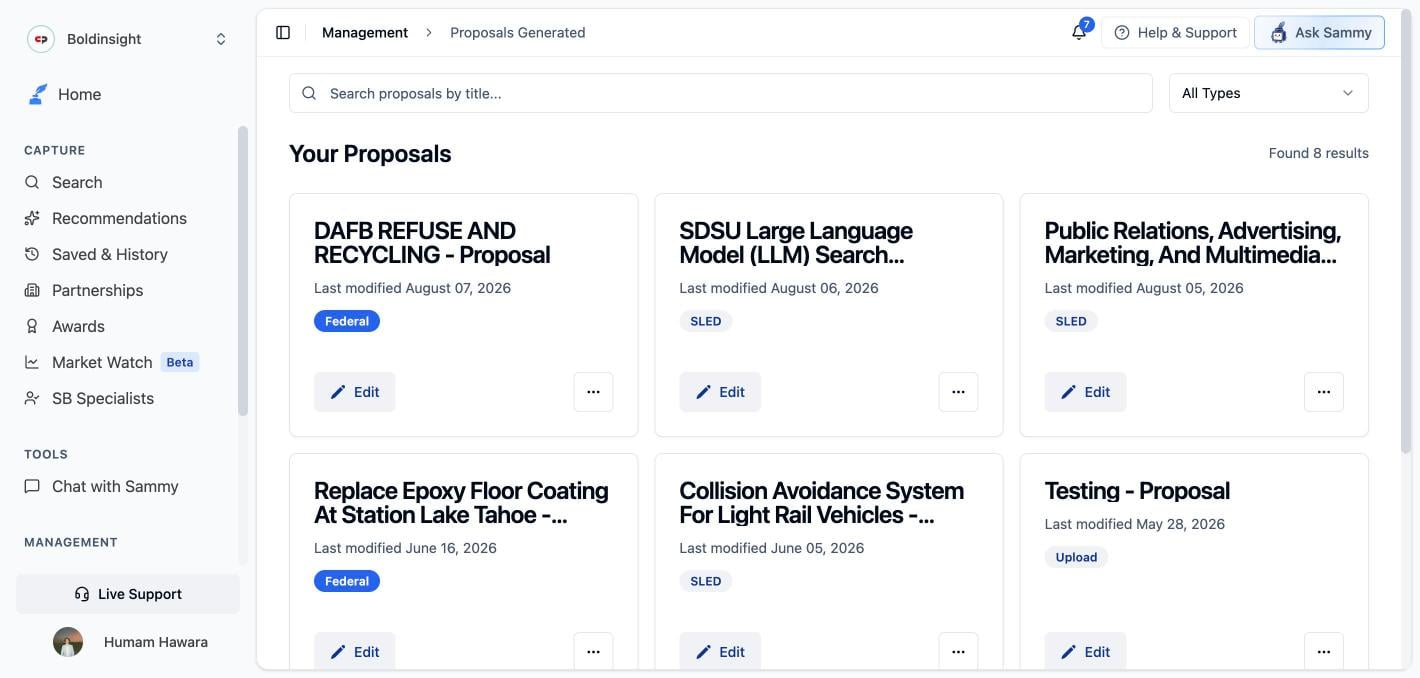
Proposal Generation is included with the Pro and Enterprise plans. Without it, you’ll see “Access denied — Please upgrade your account to access this page” instead of the generator. See Plans & upgrades.
Overview
SamSearch’s proposal generation combines your RFP requirements, company profile, uploaded documents, and the opportunity’s extracted requirements to produce a first-draft proposal — grounded in your real documents rather than generated from scratch. Three mechanisms work together to keep the draft grounded in what you actually gave it:- A document-sufficiency check runs before anything is generated. See How grounding actually works below.
- Every claim in the draft can be traced back to a specific compliance requirement, with inline citations and a coverage panel showing exactly what’s addressed and what isn’t.
- Content the AI can’t respond to from your data is flagged, not invented — as an in-line action tag you review and resolve, not a silently-fabricated paragraph.
Step-by-Step
1
Add the Opportunity to Journey Hub
Open any opportunity and click Start Journey. This creates a Journey workspace where proposal generation lives, and keeps the journey linked to the live listing for amendment tracking.
2
Select Documents
Go to the journey’s Submit tab. Generation needs two things:
- At least one journey document — the solicitation itself, so there’s something to analyze
- At least one Company Profile document you check off — capability statements, past performance, certifications — so there’s something to write from
If you connected Google Workspace, you can import documents directly from Google Drive. Set up the integration →
3
Generate Outline
Click Generate Outline. The AI reads the solicitation and your selected documents to produce, together: a section-by-section proposal outline, a bid checklist, a compliance matrix, and the Strategy Insights brief (recommendation, win themes, risks, key dates).Generation runs in the background — you can navigate away and come back. You’ll receive an email when the outline is ready, and if your organization has Teams or Slack connected, a message is also posted to your team channel.Review the outline and customize as needed — add sections, edit titles, adjust page counts, or delete sections that don’t apply. An optional Writing guidance field lets you steer the eventual proposal draft in plain text (e.g. “Emphasize our 10 years with this agency”).
4
Review the Compliance Matrix
Check the Compliance tab for your overall compliance rate. Address any Non-Compliant or Partial rows before generating — create a task directly from a gap, or update your documents and re-shred requirements. Learn more →
5
Generate Proposal
Click Generate Proposal (or Generate All Documents for a multi-document bid — e.g. a separate Technical Volume and Pricing Narrative). The AI drafts the full proposal using your outline, documents, and compliance data.
6
Review action tags
Content the AI flagged rather than invented shows up as small colored tags inline in the draft, grouped by priority in the Action Items panel:
- Data — needs a fact, figure, or verification you haven’t provided yet
- Citation — needs a source or reference
- Review — needs a subject-matter expert’s eyes before it’s final
7
Edit with Sammy
In the proposal editor, select any text and ask Sammy for help:
- “Make this more concise”
- “Does this address Section L.4?”
- “Rewrite to emphasize our past performance”
- “Add specific metrics here”
- “Add a diagram of our project org chart”
/ anywhere in the editor for formatting options: headings, tables, images, lists, and more.8
Export
Open the download menu at the top of the editor and choose Preview & export. A live preview shows exactly what will download before you commit, using whichever template is selected.
- Word (.docx) — for further editing in Microsoft Word
- PDF — for final submission or review
.docx with your organization’s fonts, headings, margins, and letterhead once, and every export uses it automatically. Two built-in templates (“SamSearch GovCon Classic” and “SamSearch GovCon Modern”) are always available if you don’t have your own.If a figure can’t be embedded in the export (for example, a legacy diagram drawn by a third-party service that’s no longer supported), the export still completes — that figure’s caption is kept in place of the image, and you’ll see a warning listing exactly which figures were skipped.
The Submit tab: Response Plan and Bid Checklist
Proposals live on a journey’s Submit tab (labelled Beta). Alongside the generated draft, that tab holds the two planning surfaces that connect your compliance requirements to the finished document.Response Plan
The Response Plan is your proposal’s outline, and it is the bridge between the Compliance Matrix and the draft. It’s a hierarchically numbered table (1, 1.3, 1.3.1, 2, 2.1, 2.1.1 …) with a row per section:
A page-limit counter sits next to the plan title — for example
32 / 32 page limit — totalling the Pages column against the solicitation’s stated limit, so you can rebalance sections before drafting rather than cutting after.
Two more controls sit above the table:
- Import from CSV — bring in an outline you’ve already built in a spreadsheet instead of adding sections by hand.
- Add Section — append a new top-level section.
Bid Checklist
A side panel tracks everything standing between you and submission, with a progress count (e.g.0/6) and the submission deadline. Items are grouped by phase:
- Prerequisites — “Resolve these before drafting starts.” Typically documents you must obtain, each with an Upload action.
- Drafting — “Can be worked on in parallel.” The volumes themselves, with a Draft Proposal or Fill Form action depending on whether the item is a narrative or a form.
Fill Form on a Bid Checklist item is how you reach Fill & Sign for attachment-style volumes such as Past Performance Information. Fill & Sign isn’t a separate tab — it opens from the checklist item or from the document itself.
Regenerating and reanalyzing
- Regenerate Proposal rebuilds the draft from the current Response Plan and documents.
- Reanalyze re-reads the source documents — use it after uploading an amendment, in tandem with Re-shred requirements on the Compliance tab.
How grounding actually works
SamSearch doesn’t rely on a single “never lie” instruction — it uses a document-sufficiency gate before generation even starts, plus a citation and traceability system on the finished draft. Before generation: the sufficiency check. Every solicitation document is assessed for whether it actually contains enough to work with. Documents with almost no readable text are rejected automatically; the rest are read more closely, and the result lands in one of three states:
After generation: citations and coverage. Every passage in the draft that responds to a specific solicitation requirement carries a small citation marker. Hovering it shows which requirement it addresses and links back to that row in the Compliance Matrix. The editor’s Coverage panel cross-references every citation actually present in your draft against the full compliance matrix, so you can see at a glance which requirements are cited and which are not yet addressed — a direct, checkable link between what you wrote and what the solicitation asked for, rather than a general accuracy promise.
What the AI won’t do: fabricate a fact it wasn’t given. Rather than inventing pricing, proprietary technical data, or a contact-specific detail it has no source for, that content is left as an action tag for you to fill in — see Review action tags above.
Collaborative Proposal Editor
The proposal editor runs on a shared document, so your whole team can work in the same draft at once instead of emailing versions around or overwriting each other’s work. This is live, real-time co-editing — you’ll see teammates’ cursors and changes appear as they type, in the same draft.- Comments in the margin — Select any passage and leave a comment anchored to it in a clean side rail. @mention a teammate to notify them and start a discussion without leaving the editor. Resolve a thread once it’s addressed.
Comments and co-editing use the same team and permission structure as the rest of Journey Hub — invite teammates from Settings → Team & Organization to give them access to a journey’s proposal draft. Learn more →
Sammy Edits You Can Review
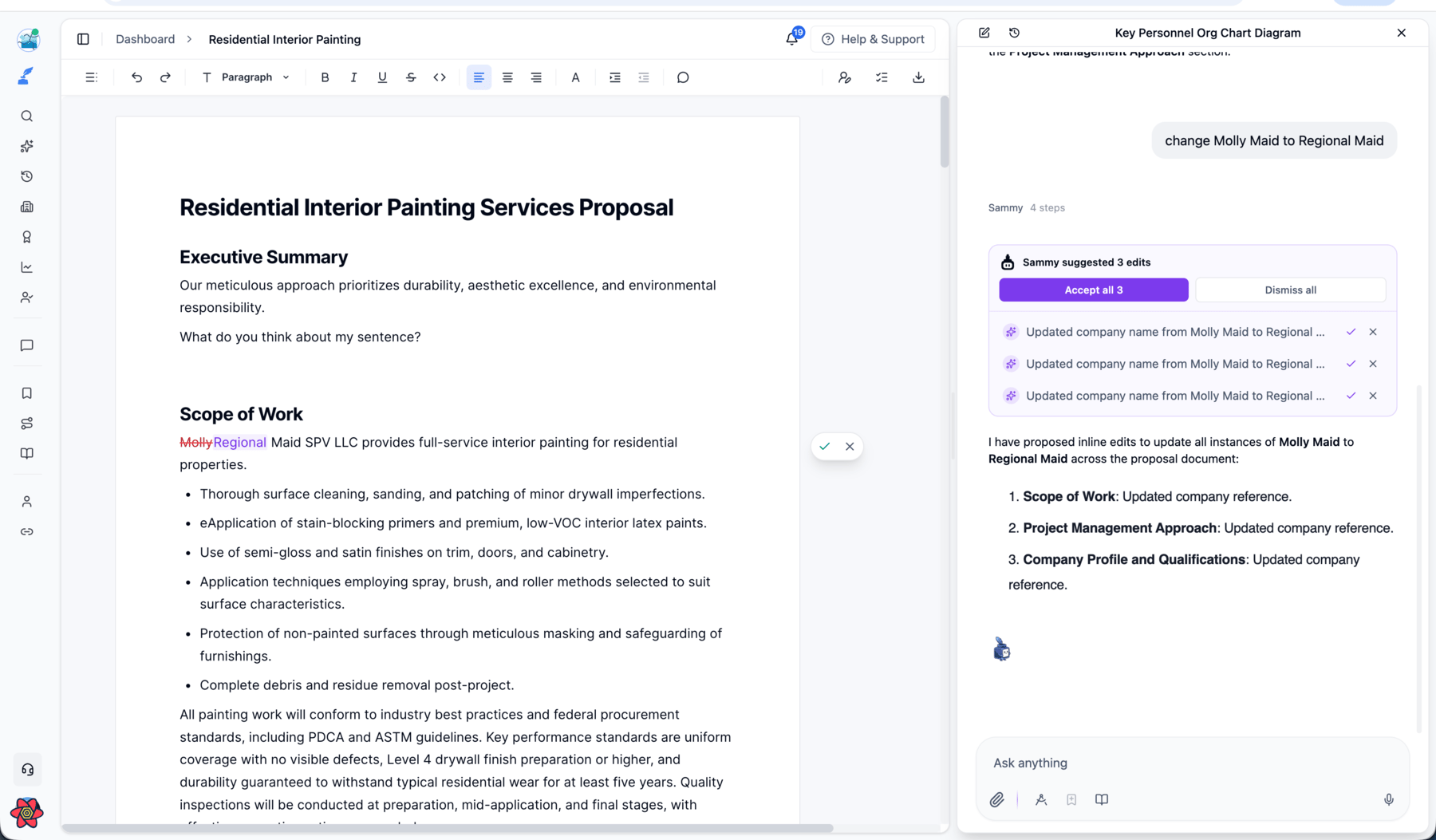
When you ask Sammy to rewrite or tighten a section, its edits don’t overwrite your text directly — they appear inline as a tracked diff so you can see exactly what changed before it lands, shown as a small accept/reject pill in the margin next to the changed passage.- See changes before they land — review the addition and deletion as a word-level diff, with a toggle to preview the resulting document. Hovering the pill shows Sammy’s rationale for the change and which requirements it’s meant to satisfy.
- The document is never touched until you accept — a pending suggestion is a visual overlay only; rejecting it removes the overlay and nothing was ever written to your draft.
- One at a time, or all at once — step through Sammy’s suggestions individually, or accept/reject a whole batch together.
Diagrams from Sammy
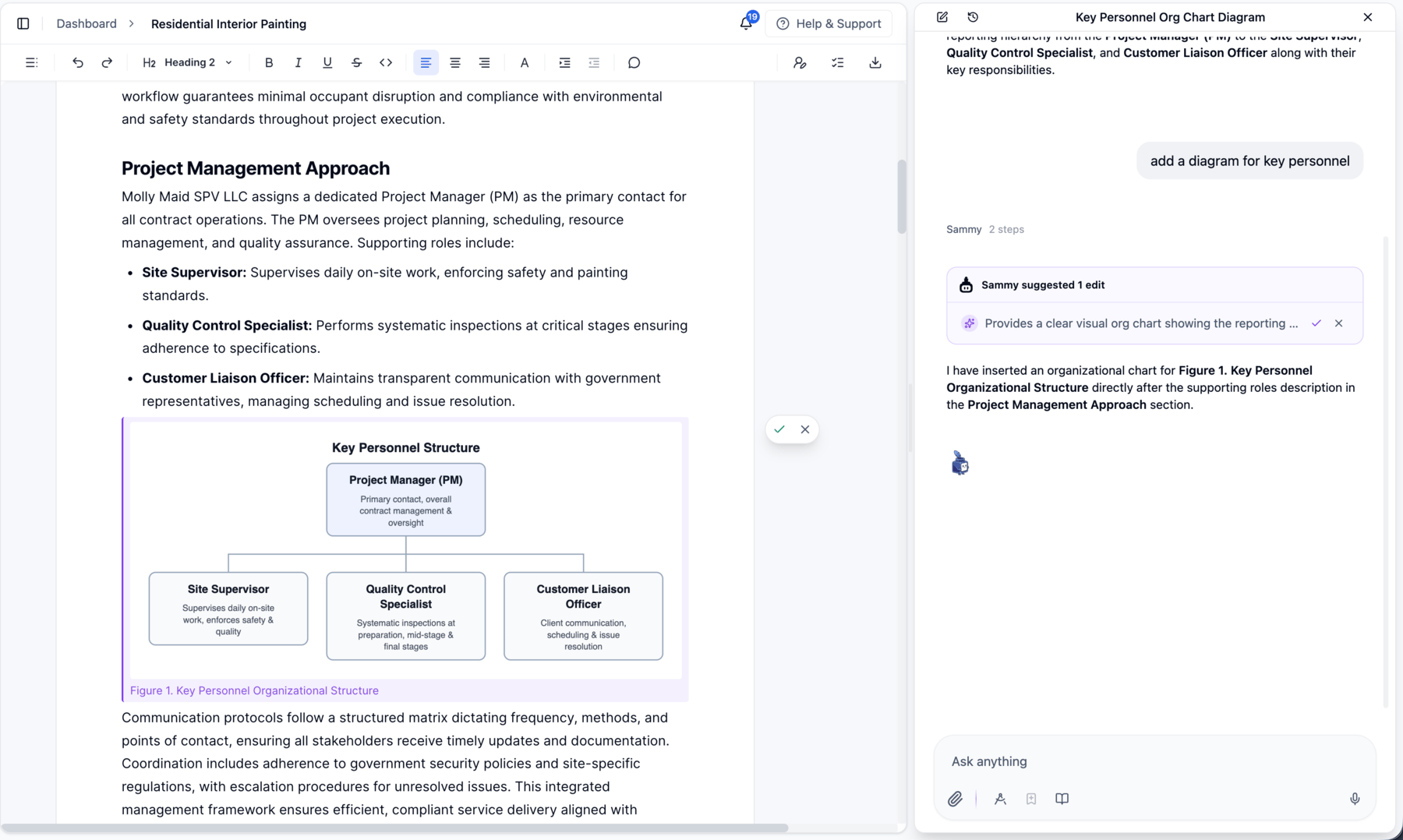
Sammy can generate diagrams and images directly into your proposal — an org chart, a process flow, a system architecture diagram, and more.- Ask for a diagram — request it the same way you’d ask for a rewrite, e.g. “Add an org chart for the project team” or “Show the onboarding process as a flow diagram.”
- Adjust in place — hover any Sammy-generated image or diagram for controls to align it, preview it full-screen, download it, or ask Sammy to revise it — no need to regenerate from scratch. Revising a diagram replaces the original in place rather than adding a second copy beside it.
DIBBS Proposals
For Defense Logistics Agency (DIBBS) opportunities, the proposal flow has a specialized path built around form-filling rather than narrative writing:- SamSearch extracts line items and part numbers from the solicitation PDF
- Relevant standard forms are matched and attached to the journey, ready for Fill & Sign
- You fill in your pricing and any incumbent pricing you have visibility into
- The completed forms export alongside the rest of your submission package
Fill & Sign
Not every submission requirement is a narrative section — solicitations often include standard federal forms that need to be filled out and signed. Fill & Sign lets you do that without printing anything.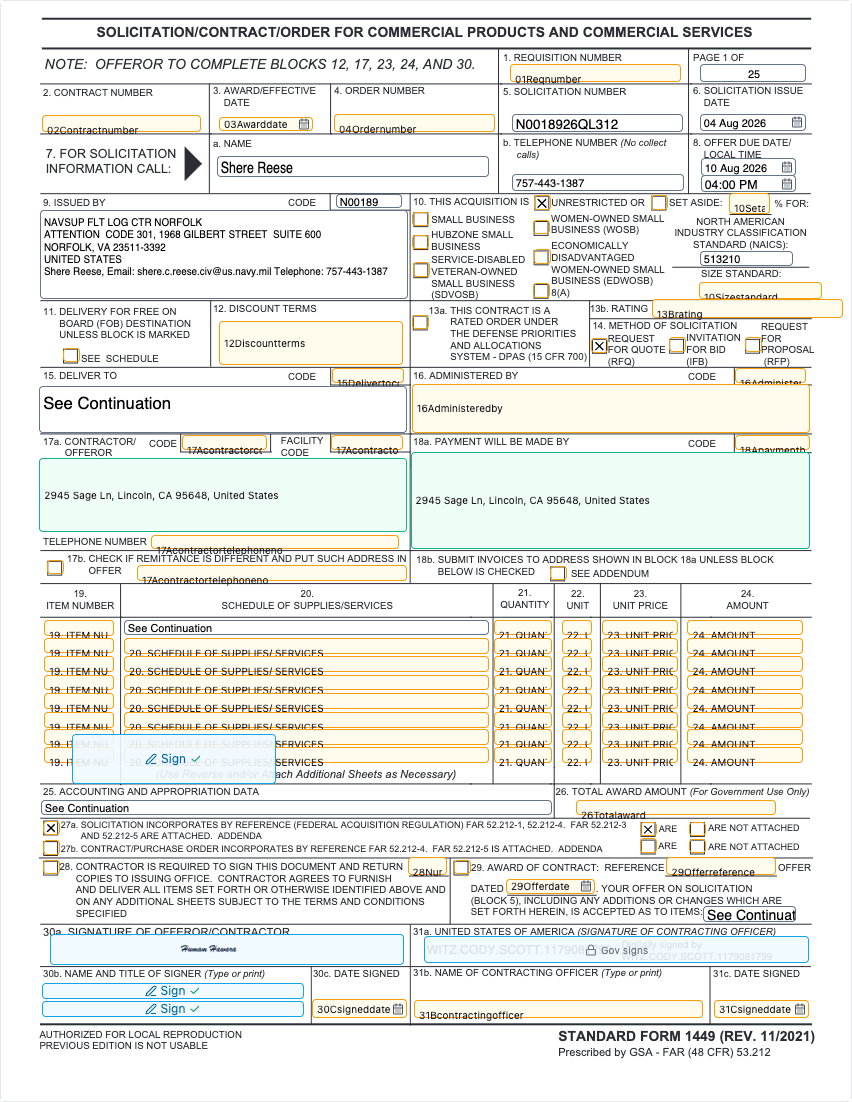
- Open any PDF or Word form from a journey’s Documents tab (row menu → Fill & Sign), or from the Bid Checklist for a form the checklist already identified
- Fields are detected automatically; each is color-coded by how it was filled — auto-filled from your profile, already present in the source PDF, needs your input, or a Sammy suggestion awaiting your review
- Add your signature (draw, type, or reuse your last one from this session) — a government-signed block is shown locked and is never something you’re prompted to sign
- Click Generate filled PDF to save the completed form back to the journey, alongside your other bid documents
Common federal forms are recognized automatically, so fields line up correctly without manual mapping. Your progress is saved as a draft as you go, so you can leave and pick up exactly where you left off.
Best Practices
Before Generating
Complete your Company Profile, upload past performance and capability statements there (not just in one journey), select only relevant documents, and check the compliance score.
During Review
Work through every action tag. Use the Coverage panel to confirm requirements are actually cited. Use Sammy to sharpen the language, and review its edits as tracked changes before accepting them.
Before Submitting
Run through the Submit tab’s bid checklist. Have a second person review pricing and technical claims. Preview your export before downloading the final format.
FAQ
Does the AI ever make up facts about my company?
Does the AI ever make up facts about my company?
No — that’s the point of the sufficiency gate and the action-tag system. If the AI can’t ground a claim in your documents or the solicitation, it leaves that spot flagged for you to fill in rather than inventing an answer. See How grounding actually works above.
What if the outline comes back without a narrative section?
What if the outline comes back without a narrative section?
This means the solicitation’s technical requirements weren’t detailed enough to build one — you’ll see a “Technical outline withheld” banner explaining why, and the bid checklist is still generated from what is available. Upload a more complete solicitation document (or the missing sections) and regenerate.
What if generation is blocked entirely?
What if generation is blocked entirely?
The solicitation document didn’t have enough readable text to work with at all — commonly an unreadable scan or a document that’s just a cover page. The message tells you specifically what’s missing; add a better copy of the document and try again.
Can I use my own proposal template?
Can I use my own proposal template?
Yes — upload a
.docx with your fonts, headings, margins, and letterhead in the export template manager, and set it as your org default. Two built-in SamSearch templates are always available as well.Can I generate multiple documents for one bid?
Can I generate multiple documents for one bid?
Yes. For bids that need separate volumes (e.g. Technical Volume and Pricing Narrative), each is generated and edited as its own document, switchable from a document tab strip above the editor.
Can multiple people edit a proposal at the same time?
Can multiple people edit a proposal at the same time?
Yes. The editor runs on a shared document — teammates co-edit the same draft at once, with live cursors and changes. Leave comments anchored to a passage and @mention a teammate to loop them in.
Does Sammy overwrite my text when I ask it to edit?
Does Sammy overwrite my text when I ask it to edit?
No. Sammy’s edits appear inline as a tracked diff — you accept or reject each change before anything is finalized in your draft. The document isn’t touched until you accept.
Can Sammy add diagrams or images to my proposal?
Can Sammy add diagrams or images to my proposal?
Yes. Ask Sammy for a diagram — an org chart, a process flow, and similar visuals — and it’s inserted directly into the draft. Hover it for controls to align it, preview it, or ask Sammy to revise it.
Where do I fill out and sign a required federal form?
Where do I fill out and sign a required federal form?
Open the form from the journey’s Documents tab and use Fill & Sign to complete and sign it in the browser — no printing required. Common federal forms are recognized automatically so fields line up correctly.